

Selling the House in a North Carolina Divorce
NC's one-year separation rule, how equitable distribution starts at equal, why both spouses usually sign, and what a buyout or a sale really costs.
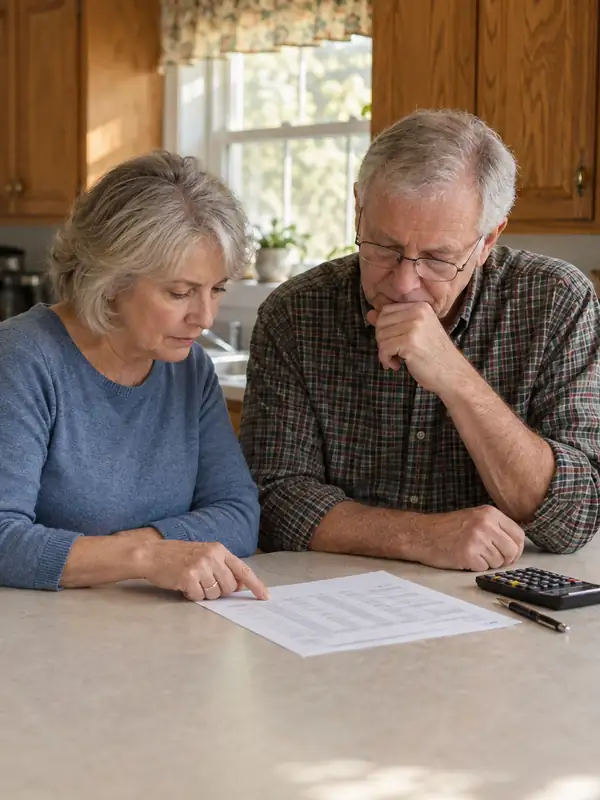
A line-by-line walk through a North Carolina seller’s settlement statement: the $1-per-$500 excise tax, prorations, title fees, and what a cash sale removes.
Prefer to talk it through? Call (984) 489-8269
Nobody is surprised by the commission. Everybody is surprised by the settlement statement.
It arrives a day or two before closing, it is two pages of line items in an order nobody explains, and it is the first time most sellers see the actual number they are walking away with. By then it is late to be learning what a "prorated tax" line is or who is supposed to pay the excise tax.
This is a walk through what a North Carolina seller is typically asked to pay, what the statute actually assigns to the seller, and what a cash sale removes from the list. Figures from outside sources are labelled as estimates and linked; the only numbers we state as our own are the ones we publish about our own offers.
What do you want to know first?
Rather talk to a person? Call (984) 489-8269
Read a settlement statement as four groups rather than twenty lines.
Government charges. The excise tax on the conveyance, and any recording fees for documents cleared at closing — a satisfaction of your deed of trust, for instance.
Title and settlement. North Carolina closings are attorney-involved, and there are fees for the settlement work, title search, courier and recording services. In North Carolina the buyer usually pays for owner's title insurance, though a contract can shift it, and some estimates (including Clever's below) count it as a seller cost. A lender's policy is the buyer's lender's requirement.
Payoffs and liens. Your mortgage payoff, any home equity line, judgments, unpaid HOA assessments, and tax liens. These are not "costs" so much as debts settled from proceeds, but they come out of the same pot and they belong in your arithmetic.
Prorations and credits. Property taxes for the portion of the year you owned the home, HOA dues, any agreed repair credit, and any concession toward the buyer's costs.
That last group produces most of the surprises. Property taxes in North Carolina are billed for the year, and at closing the year is divided between you and the buyer — so a sale in autumn typically leaves the seller responsible for the larger share. If the bill is already paid, and NC bills are due September 1, that share comes back to you as a credit rather than a charge. Either way it is not a fee. It is a bill you were always going to pay, settled on a date you did not choose.
For the size of the whole package, the clearest-sourced third-party estimate we found is Clever's North Carolina seller closing costs breakdown, last updated 2026-02-05, which names its own sources — the NC Department of Revenue for property tax rates, a title insurer's rate calculator, and the excise tax statute. It puts the state average at about 2.58% of purchase price, and separately estimates the individual items behind it — buyer incentives, prorated property taxes, transfer taxes, title service fees and title insurance, in roughly that order of size. Those component estimates are made independently of one another and do not add up to the 2.58% headline, so treat the headline as the rough total and the component list only as a guide to which items are big.
Treat that as an estimate of a statewide average, not a quote. Your county, your price point, your contract and your lender all move it.
This is the one item where North Carolina law, rather than custom, decides.
N.C.G.S. § 105-228.30 imposes an excise tax on each instrument conveying an interest in real property, at the rate of $1.00 on each $500.00 or fractional part of the consideration or value of the interest conveyed. The statute is equally clear about who pays: the tax is payable by the transferor — the seller — to the register of deeds of the county where the land lies, before the instrument may be recorded.
The arithmetic is $2 per $1,000, so:
Note "or fractional part": the tax rounds up to the next $500 increment, which is why a sale at $300,100 pays the same as one at $300,500.
You will also see this called a "transfer tax" or a "revenue stamp" on an estimate. Same thing. Ask your closing attorney to confirm the recording and transfer charges that apply in your county rather than assuming the state rate is the whole of that line.
No commissions, and we pay the standard closing costs. See your number.
A free cash offer on your house. No obligation.
No obligation. You decide after you see the offer in writing.
Prefer to talk it through? Call (984) 489-8269
Many "average cost to sell" figures quietly fold commission into closing costs, or quietly leave it out. Both make the number misleading.
Keep them separate, because they behave differently. Excise tax is fixed by statute. Title fees are set by service providers. Commission is negotiated — between you and your listing broker, and increasingly between the parties for the buyer-side portion, which no longer moves automatically with the listing agreement the way it once did.
As a statewide anchor, the same Clever page estimates average North Carolina realtor fees at about 5.59% — roughly 2.79% to the listing agent and 2.81% to the buyer's agent. On a $300,000 sale that is around $16,800, roughly twice the estimated closing costs on the same sale (about $7,700 at 2.58%).
So when you compare selling paths, compare price minus commission minus closing costs minus repairs and concessions. Anything else compares a gross number to a net one, and the gross number always wins that fight.
Ours removes three things, and it is worth being precise about which three.
Commission. There is no agent on our side. We are not licensed real estate brokers; we buy directly from homeowners. That is also why there is no financing contingency to clear.
Closing costs to you. We pay them. Our answer on fees and hidden costs puts it plainly: zero commissions, zero closing costs, no service fees, and no repair deductions for things found after signing. The cash offer we give you is what you receive at closing, minus only your mortgage payoff and any liens.
Repair and inspection credits. There is no post-signing renegotiation. Our offer is built on the condition you describe to us.
What a cash sale does not remove is your mortgage payoff, or any liens and judgments attached to the property — those are paid from the proceeds in any sale, to anybody. And it does not remove the excise tax from existence; it simply is not deducted from your number. Nor does it make the price a retail price: a cash offer is below what a renovated house would fetch, and the comparison worth running is our net against your listing net, which is exactly the arithmetic in cash offer vs listing.
Getting a number costs nothing either way. There is no cost to talk to us or get an offer, and no obligation attached to one.
See what a cash sale leaves you with, in writing, before you decide.
There is no single correct figure, and be sceptical of any page that gives one without a source. The one item fixed by law is the excise tax at $1 per $500 of consideration, paid by the seller. For the rest, the best-sourced statewide estimate we found is Clever's 2.58% average, with commission estimated separately at about 5.59%. Your own settlement statement is the only number that is actually yours; ask your closing attorney for an estimate early rather than the day before closing.
Mostly, whoever the contract says. Custom splits them — sellers typically carry the excise tax, their own payoff and recording costs, and prorated taxes to the closing date, while buyers typically carry lender-related charges and their own title work — but almost all of it is negotiable, and buyer concessions (money you agree to put toward the buyer's costs) have become a real seller cost in a balanced market. The excise tax is the exception: § 105-228.30 assigns it to the transferor by statute.
With us, nothing is deducted from the agreed price — no commissions, no closing costs, no fees. That is our practice and it is written into what we sign, not a general rule about cash buyers, so ask any buyer to point at the clause that says it. Your mortgage payoff and any liens still come out of the proceeds, as they would in any sale.
If you want a real number instead of a percentage, you can get a written cash offer in 24 hours at no cost, or just ask us a question about a line item you do not recognise on an estimate someone else gave you. We would rather you understood the settlement statement and listed the house than signed something you did not understand.
We answer directly, no phone tree. A 15-minute conversation about your property and your situation.
No visit is needed before the offer. Don't clean, don't stage. We've seen it all.
Clear math, and we explain how we got to the number. Close in 14–30 days, or later if you need more time.
Takes about a minute.
or call (984) 489-8269
NC's one-year separation rule, how equitable distribution starts at equal, why both spouses usually sign, and what a buyout or a sale really costs.
The lease survives the sale, the deposit must move within 30 days under § 42-54, and § 42-14 sets the notice. What NC landlords actually have to do.
What the NC REALTORS® August 2026 figures say about supply, closed sales and price tiers — and why your circumstance usually sets the date, not the market.
Get a written cash offer within 24 hours of your call. No pressure, no obligation, no cost.
Rather talk to a person? Call (984) 489-8269
No obligation. You decide after you see the offer in writing.